Discovery
Netflix - Watch Party
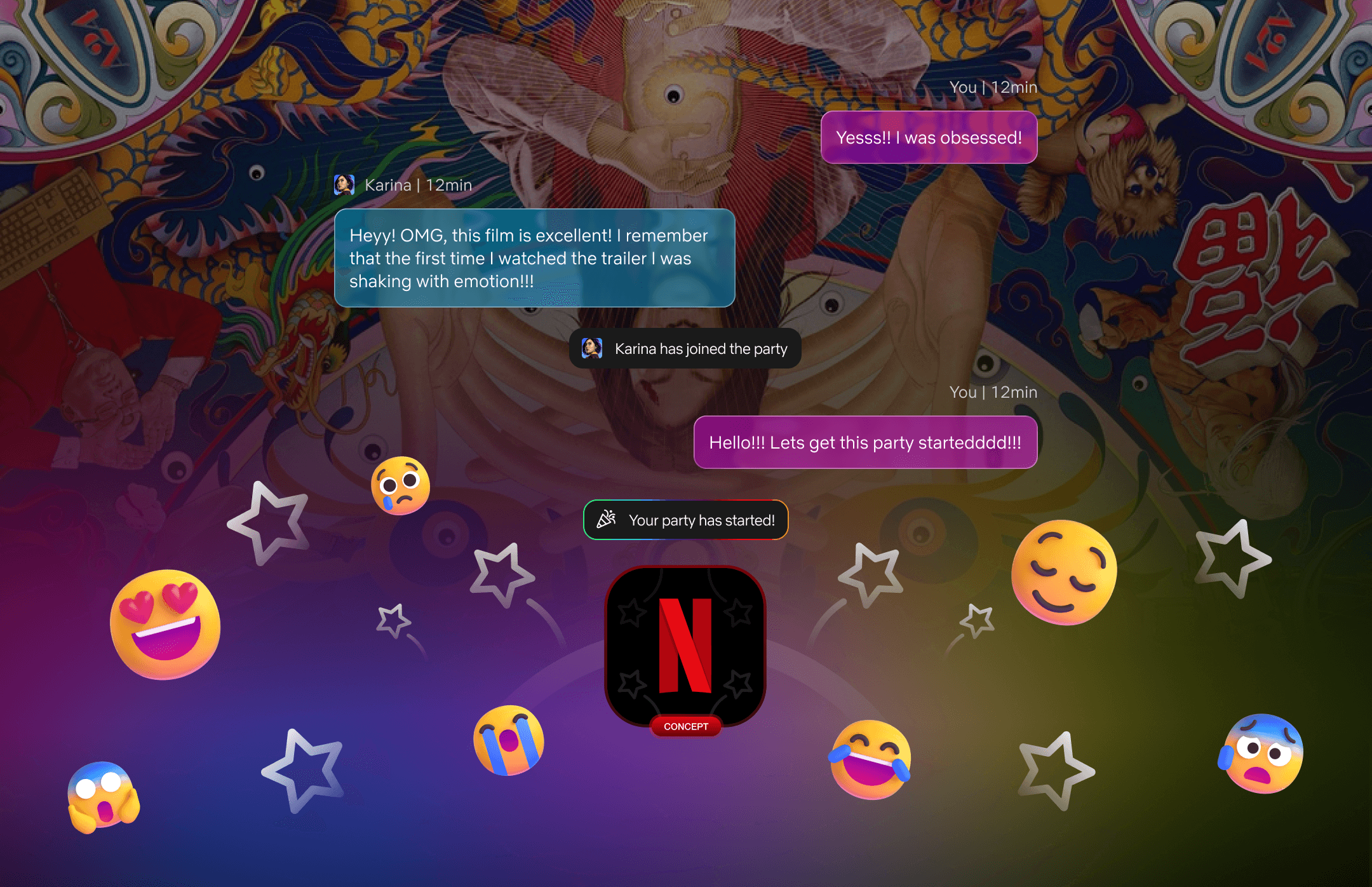
A proof of concept exploring a social chat experience integrated into the Netflix ecosystem, designed to enable real-time interaction between users directly within the mobile and TV apps. The project investigates how social features—such as shared conversations, reactions, and contextual chat tied to content—could enhance engagement, co-viewing, and the overall entertainment experience without disrupting the core viewing flow.
Year :
2023
Industry :
Streaming
Client :
Study Case
Project Duration :
1 Week
Problem Statement
What problem are we solving?
The consumption of audiovisual content is increasingly fragmented: people watch the same series and movies while geographically separated, but they want to share this experience in real time with friends and family.

“How might we transform the solitary act of watching into a native social experience within Netflix, without breaking content immersion?”
Today, users rely on external solutions (Discord, Teleparty, phone calls) to simulate a shared viewing session, creating friction, synchronization issues, and forcing them to leave the Netflix ecosystem. This represents a direct opportunity to increase retention and engagement.
Netflix also loses social engagement to platforms like YouTube and Twitch, which already offer native real-time interaction features. A Watch Party feature would help reduce this disadvantage while creating a new acquisition channel through social invitations.
User Retention
Social Engagement
Churn Reduction
Multi-Device Experience
Child Safety
User Retention
Social Engagement
Churn Reduction
Multi-Device Experience
Child Safety
User Retention
Multi-Device Experience
Social Engagement
Child Safety
Churn Reduction
Discovery — Quantitative Survey
Methodology
To ground the solution in real user behavior, a quantitative survey was conducted with a diverse group of Netflix users. The goal was to validate assumptions around social viewing, identify existing pain points, and understand expectations for a native group-watching experience. The questionnaire was designed to be concise yet insightful, combining behavioral questions with attitudinal prompts to capture both current habits and latent needs related to shared content consumption.
Online survey sent to
0
0
active Netflix users
The research covered users from
0
0
>
0
0
years of age.
Frequent consumers of movies and series
Online survey sent to
0
0
active Netflix users
The research covered users from
0
0
>
0
0
years of age.
Frequent consumers of movies and series
Online survey sent to
0
0
active Netflix users
Frequent consumers of movies and series
The research covered users from
0
0
>
0
0
years of age.
Key Insights
The survey results revealed a strong desire for social interaction during content consumption, alongside clear friction with existing workarounds. Users demonstrated high interest in a native solution that would allow them to stay connected with friends without leaving the viewing experience. The insights highlighted the importance of mobile as the primary interaction device, the value of lightweight and expressive communication (such as reactions and audio), and the need for seamless synchronization between devices. These findings directly informed the product direction and design decisions explored in the concept.
0%
0%
already comment on movies/series while watching
0%
0%
use third-party apps to do so
0%
0%
expressed strong interest in a native social feature
0%
0%
prefer typing on mobile while watching on TV
0%
0%
are interested in audio or video interactions for specific moments
These findings supported a mobile-first input strategy with TV-focused visualization.
How Data Guided the Decisions
0%
0%
Together, Even When Apart
Justifies real-time playback synchronization as a core feature, not an optional one.
0%
0%
Users use external apps to discuss content while watching.
Integrated reactions and voice messages eliminate the need to leave Netflix.
0%
0%
Users use their phones as a second screen
prioritizing a mobile experience with Watch Party controls while content plays on the main screen.
0%
0%
Users abandoned viewing sessions
enabling direct measurement of retention impact, as this feature addresses a measurable source of churn.
Personas
Who Uses Watch Party?
Research insights revealed three key user profiles that represent the main use cases, motivations, and challenges the product needs to address.

Julia
Student - Age 18
Job to be done
“I want to watch shows with my high school friends without having to coordinate schedules or download another app.”
Pain Points:
Manually syncing playback during phone or video calls.
Getting spoiled by conversations happening in WhatsApp groups.
Feeling left out of the shared experience due to a slower internet connection.

Ricardo
Developer - Age 34
Job to be done
“I want to rewatch classic movies with my brother who lives in another city, just like we used to when we lived together.”
Pain Points:
Device latency disrupting shared reactions and key moments.
Lack of voice communication — jokes and emotional moments lose impact when limited to text.
An outdated and unreliable Teleparty interface that creates friction during the viewing experience.

Mariana
Professor - Age 45
Job to be done
“I want to be able to watch movies with my mother in another city, safely and without needing complicated technical assistance.”
Pain Points:
Concerns about exposure to inappropriate content for children.
Setup complexity that can be confusing for older users.
Lack of parental controls in shared viewing sessions.
Proposed Solution
Watch Party
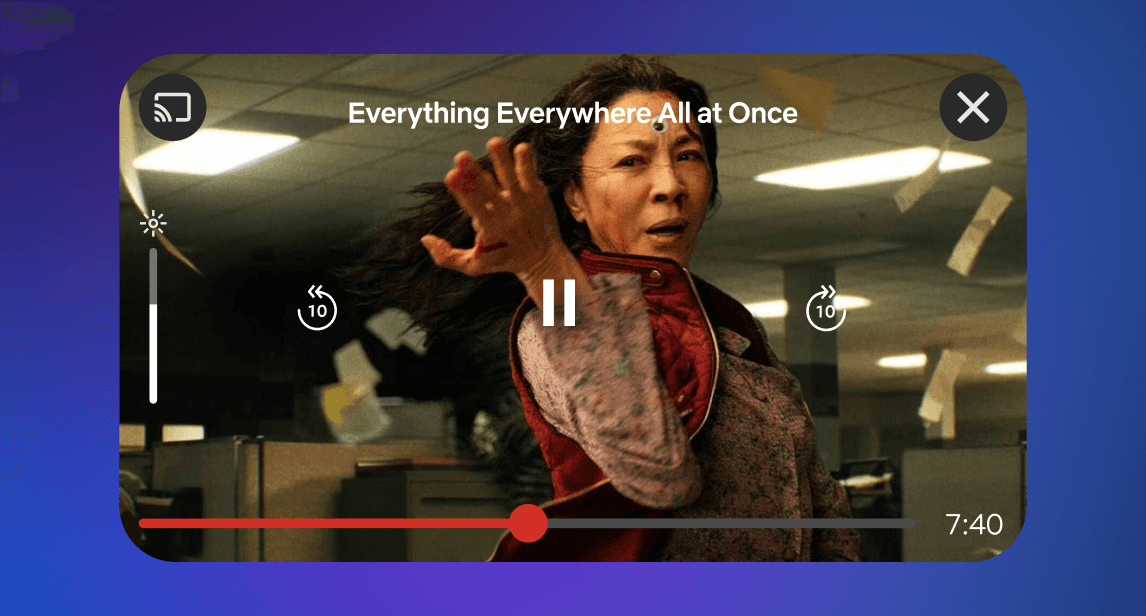
The solution is Watch Party, integrated directly into Netflix’s playback experience. A viewing session is created by a host, and participants can join through an invitation link shared via WhatsApp, Messages, Twitter/X, or a direct link.
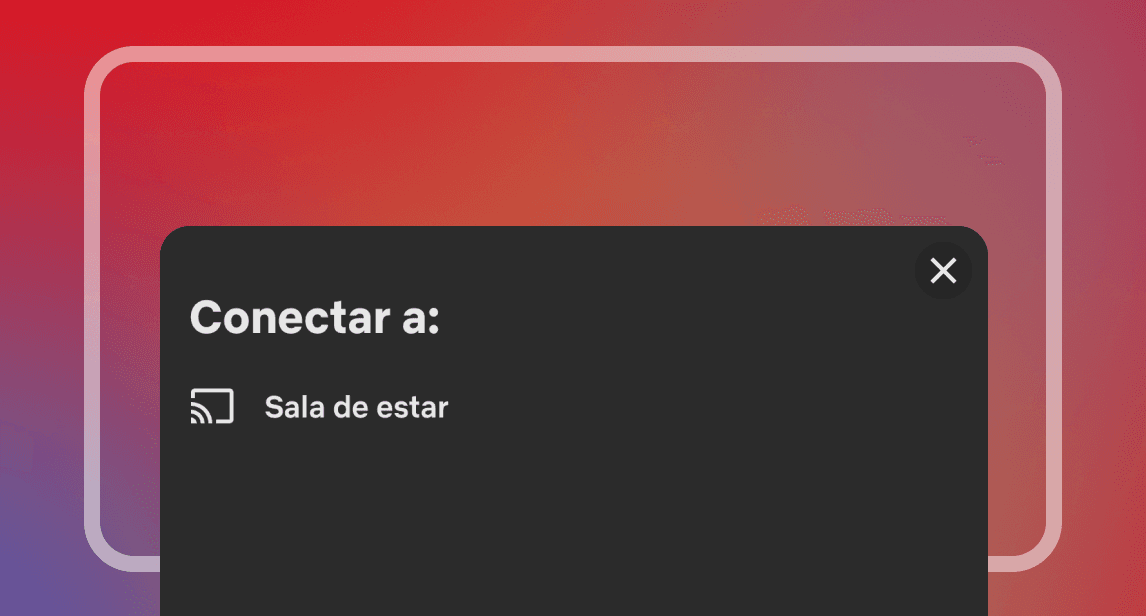
Core Capabilities



user flow
End-to-End Journey
We mapped the host’s primary journey, from the moment they decide to create a Watch Party session through its completion, while also considering the most relevant edge cases uncovered during research.
You can navigate on the prototype bellow.
Happy path — Host

Happy path — TV connection

Critical Edge cases


Experience Architecture
Mobile ↔ TV
The Watch Party experience was designed to operate seamlessly across mobile and TV, recognizing that 67% of users use their phones as a second screen. The separation of responsibilities between devices is intentional: the TV remains focused on the content, while the mobile device serves as the social interaction hub.
Mobile
Watch Party session creation and management
Screen sharing and invitation integration
Keyboard support for text messages and quick reactions
Chat, emoji, and voice message interface
Ability to chat with any participant across devices in the group
TV
Content-first viewing experience with minimal distractions
Lightweight overlay for participant reactions and avatars
Presence indicator showing who is currently in the session
Simplified navigation and controls optimized for TV remotes
Automatic synchronization of play and pause actions across the group
Design decision:
We chose to centralize all social interactions on mobile while keeping the TV dedicated exclusively to content consumption. This approach avoids the cognitive overload of managing interactions with a remote control—an imprecise input method with no keyboard support—and aligns with a behavior already observed during research: 67% of users naturally use their phones as a second screen, even without this feature in place.
Decisions & Trade-offs
Why Was Each Choice Made?
Every Watch Party feature was evaluated against alternative approaches before being included in the final solution. Documenting these trade-offs is essential to demonstrating product maturity, design decisions are not driven by personal preference, but by user needs, business priorities, technical constraints, and contextual considerations.
Playback Control: Host-only control vs. shared control for all participants.
✓ SELECTED — HOST-ONLY PLAYBACK CONTROL
Prevents synchronization conflicts by establishing a single source of truth for play, pause, and seek actions. It also enables the host to pause the session for everyone when needed, ensuring a consistent shared viewing experience.
✗ REJECTED — DEMOCRATIC PLAYBACK CONTROL
Simultaneous actions from multiple participants create synchronization conflicts and disrupt the shared viewing experience. Differences in network latency can further increase playback inconsistencies, making the experience increasingly chaotic as the group grows beyond four participants.
Product logic: We preserve flexibility by allowing the host to transfer playback control to another participant when needed, without compromising consistency or introducing synchronization conflicts.
Session Entry: Open invitation link vs. host approval for each participant.
✓ SELECTED — 30 MINUTE EXPIRING LINK
Provides a frictionless invitation experience through a single sharing action. Security is maintained through a limited access window, preventing late or unauthorized entries once the link expires. Child profile verification was also added to ensure age-appropriate access and protect younger users.
✗ REJECTED — MANUAL HOST APPROVAL
Introduces unnecessary friction by requiring the host to be available to approve every participant individually. It also interrupts the viewing experience when the session is already underway, creating a barrier to seamless participation.
Product logic: Social invitations already act as a natural access filter—the people who receive the link are the people the host intends to invite. Manual approval adds friction to the experience without providing a proportional increase in security, making it a poor trade-off for this context.
Group Video: Always-on camera vs. optional picture-in-picture video.
✓ SELECTED — OPTIONAL PIP VIDEO, CAMERA OFF BY DEFAULT
Respects user privacy and reduces data consumption. Participants who want to share their reactions can enable their camera, while those who prefer to simply listen can keep it off. The experience remains flexible and comfortable for different social preferences, without creating pressure or judgment.
✗ REJECTED — ALWAYS-ON CAMERA
An always-active camera is intrusive, increases battery and data consumption, and may expose users’ home environments without their explicit consent. It can also discourage participation from younger users and those who are less comfortable being on camera, reducing overall adoption of the feature.
Product logic: Privacy should be the default, not an advanced setting. This approach also aligns with best design practices for platforms that serve minors, ensuring a safer and more inclusive experience from the outset.
Validation Hypotheses
How Will We Know It Worked?
Defining measurable hypotheses before launch is what transforms a design project into a product decision. The following hypotheses are considered Priority 1 for an A/B test involving 5% of the user base over a 60-day period.
HYPOTHESIS 01 — RETENTION
Users who participate in at least one Watch Party per month will have a 25% lower cancellation rate compared to users who do not use the feature.
Users who participate in at least one Watch Party per month will have a 25% lower cancellation rate compared to users who do not use the feature.
KPI: Monthly churn rate by user segment
Baseline: Current platform average churn rate
Method: A/B test with a control group.
Trust
High
HYPOTHESIS 02 — ENGAGEMENT
Watch Party sessions will have an average duration 35% longer than solo viewing sessions of the same content, driven by the social commitment effect of watching as a group.
KPI: Average session duration (minutes)
Baseline: Current average session duration by content type
Method: Comparison between Watch Party sessions and solo viewing sessions.
Trust
Medium-High
HYPOTHESIS 03 — ACQUISITION
15% of invited non-subscribers who receive a Watch Party invitation link will create an account to join the session.
15% of invited non-subscribers who receive a Watch Party invitation link will create an account to join the session.
KPI: Conversion rate of invited non-subscribers
Baseline: Current trial-to-signup conversion rate
Method: Signup source tracking through Watch Party invitation links.
Trust
Medium
HYPOTHESIS 04 — SOCIAL NPS
Users who regularly participate in Watch Party sessions will rate Netflix with an NPS score 15 points higher than the overall average of active users.
KPI: NPS by usage segment
Baseline: Current global NPS
Method: Post-session survey combined with monthly NPS tracking.
Trust
Medium-High
Guardrails — What Would Trigger a Rollout Pause?
Increase in reports of abuse or inappropriate content in sessions involving minors above 0.1% of total sessions.
Decline in overall user satisfaction (CSAT) among users who do not use the feature — invitation notifications must remain non-intrusive and should not negatively impact the core experience.
Synchronization latency exceeding 2 seconds in more than 10% of sessions — a strong indicator of infrastructure or scalability issues that should be resolved before a broader rollout.
Conclusion
Final Reflections
This project explored how Netflix could transform content consumption into a social experience without compromising playback quality. Watch Party is more than a feature, it represents a shift in positioning: from an individual streaming platform to a space for shared experiences.
Research revealed that co-viewing behavior already exists organically. Users are already watching together, discussing content through WhatsApp, and manually synchronizing playback during phone or video calls. Netflix’s opportunity is to make these behaviors native, seamless, and secure within its own ecosystem.
Design decisions were guided by three core principles that emerged from the research. First, content must always remain the protagonist—social interactions should enhance the experience, not compete with it. Second, simplicity is accessibility—the fewer steps required to join a session, the more likely users are to participate. Third, safety should be the default, not the exception, especially on a platform that serves users as young as eight years old.
Natural next steps for this initiative include usability testing with the three identified personas, validating playback synchronization infrastructure at scale, and defining a phased platform roadmap (Android → iOS → TV → Web). Together, these efforts would help determine whether Watch Party can become a meaningful driver of engagement, retention, and social acquisition for Netflix.
More Projects
More Projects

Discovery
Netflix - Watch Party
A proof of concept exploring a social chat experience integrated into the Netflix ecosystem, designed to enable real-time interaction between users directly within the mobile and TV apps. The project investigates how social features—such as shared conversations, reactions, and contextual chat tied to content—could enhance engagement, co-viewing, and the overall entertainment experience without disrupting the core viewing flow.
Year :
2023
Industry :
Streaming
Client :
Study Case
Project Duration :
1 Week
Problem Statement
What problem are we solving?
The consumption of audiovisual content is increasingly fragmented: people watch the same series and movies while geographically separated, but they want to share this experience in real time with friends and family.
“How might we transform the solitary act of watching into a native social experience within Netflix, without breaking content immersion?”
Today, users rely on external solutions (Discord, Teleparty, phone calls) to simulate a shared viewing session, creating friction, synchronization issues, and forcing them to leave the Netflix ecosystem. This represents a direct opportunity to increase retention and engagement.
Netflix also loses social engagement to platforms like YouTube and Twitch, which already offer native real-time interaction features. A Watch Party feature would help reduce this disadvantage while creating a new acquisition channel through social invitations.
User Retention
Social Engagement
Churn Reduction
Multi-Device Experience
Child Safety
User Retention
Social Engagement
Churn Reduction
Multi-Device Experience
Child Safety
User Retention
Multi-Device Experience
Social Engagement
Child Safety
Churn Reduction
Discovery — Quantitative Survey
Methodology
To ground the solution in real user behavior, a quantitative survey was conducted with a diverse group of Netflix users. The goal was to validate assumptions around social viewing, identify existing pain points, and understand expectations for a native group-watching experience. The questionnaire was designed to be concise yet insightful, combining behavioral questions with attitudinal prompts to capture both current habits and latent needs related to shared content consumption.
Online survey sent to
0
0
active Netflix users
The research covered users from
0
0
>
0
0
years of age.
Frequent consumers of movies and series
Online survey sent to
0
0
active Netflix users
The research covered users from
0
0
>
0
0
years of age.
Frequent consumers of movies and series
Online survey sent to
0
0
active Netflix users
Frequent consumers of movies and series
The research covered users from
0
0
>
0
0
years of age.
Key Insights
The survey results revealed a strong desire for social interaction during content consumption, alongside clear friction with existing workarounds. Users demonstrated high interest in a native solution that would allow them to stay connected with friends without leaving the viewing experience. The insights highlighted the importance of mobile as the primary interaction device, the value of lightweight and expressive communication (such as reactions and audio), and the need for seamless synchronization between devices. These findings directly informed the product direction and design decisions explored in the concept.
0%
0%
already comment on movies/series while watching
0%
0%
use third-party apps to do so
0%
0%
expressed strong interest in a native social feature
0%
0%
prefer typing on mobile while watching on TV
0%
0%
are interested in audio or video interactions for specific moments
These findings supported a mobile-first input strategy with TV-focused visualization.
How Data Guided the Decisions
0%
0%
Together, Even When Apart
Justifies real-time playback synchronization as a core feature, not an optional one.
0%
0%
Users use external apps to discuss content while watching.
Integrated reactions and voice messages eliminate the need to leave Netflix.
0%
0%
Users use their phones as a second screen
prioritizing a mobile experience with Watch Party controls while content plays on the main screen.
0%
0%
Users abandoned viewing sessions
enabling direct measurement of retention impact, as this feature addresses a measurable source of churn.
Personas
Who Uses Watch Party?
Research insights revealed three key user profiles that represent the main use cases, motivations, and challenges the product needs to address.
Julia
Student - Age 18
Job to be done
“I want to watch shows with my high school friends without having to coordinate schedules or download another app.”
Pain Points:
Manually syncing playback during phone or video calls.
Getting spoiled by conversations happening in WhatsApp groups.
Feeling left out of the shared experience due to a slower internet connection.
Ricardo
Developer - Age 34
Job to be done
“I want to rewatch classic movies with my brother who lives in another city, just like we used to when we lived together.”
Pain Points:
Device latency disrupting shared reactions and key moments.
Lack of voice communication — jokes and emotional moments lose impact when limited to text.
An outdated and unreliable Teleparty interface that creates friction during the viewing experience.
Mariana
Professor - Age 45
Job to be done
“I want to be able to watch movies with my mother in another city, safely and without needing complicated technical assistance.”
Pain Points:
Concerns about exposure to inappropriate content for children.
Setup complexity that can be confusing for older users.
Lack of parental controls in shared viewing sessions.
Proposed Solution
Watch Party
The solution is Watch Party, integrated directly into Netflix’s playback experience. A viewing session is created by a host, and participants can join through an invitation link shared via WhatsApp, Messages, Twitter/X, or a direct link.
Core Capabilities
user flow
End-to-End Journey
We mapped the host’s primary journey, from the moment they decide to create a Watch Party session through its completion, while also considering the most relevant edge cases uncovered during research.
You can navigate on the prototype bellow.
Happy path — Host
Happy path — TV connection
Critical Edge cases
Experience Architecture
Mobile ↔ TV
The Watch Party experience was designed to operate seamlessly across mobile and TV, recognizing that 67% of users use their phones as a second screen. The separation of responsibilities between devices is intentional: the TV remains focused on the content, while the mobile device serves as the social interaction hub.
Mobile
Watch Party session creation and management
Screen sharing and invitation integration
Keyboard support for text messages and quick reactions
Chat, emoji, and voice message interface
Ability to chat with any participant across devices in the group
TV
Content-first viewing experience with minimal distractions
Lightweight overlay for participant reactions and avatars
Presence indicator showing who is currently in the session
Simplified navigation and controls optimized for TV remotes
Automatic synchronization of play and pause actions across the group
Design decision:
We chose to centralize all social interactions on mobile while keeping the TV dedicated exclusively to content consumption. This approach avoids the cognitive overload of managing interactions with a remote control—an imprecise input method with no keyboard support—and aligns with a behavior already observed during research: 67% of users naturally use their phones as a second screen, even without this feature in place.
Decisions & Trade-offs
Why Was Each Choice Made?
Every Watch Party feature was evaluated against alternative approaches before being included in the final solution. Documenting these trade-offs is essential to demonstrating product maturity, design decisions are not driven by personal preference, but by user needs, business priorities, technical constraints, and contextual considerations.
Playback Control: Host-only control vs. shared control for all participants.
✓ SELECTED — HOST-ONLY PLAYBACK CONTROL
Prevents synchronization conflicts by establishing a single source of truth for play, pause, and seek actions. It also enables the host to pause the session for everyone when needed, ensuring a consistent shared viewing experience.
✗ REJECTED — DEMOCRATIC PLAYBACK CONTROL
Simultaneous actions from multiple participants create synchronization conflicts and disrupt the shared viewing experience. Differences in network latency can further increase playback inconsistencies, making the experience increasingly chaotic as the group grows beyond four participants.
Product logic: We preserve flexibility by allowing the host to transfer playback control to another participant when needed, without compromising consistency or introducing synchronization conflicts.
Session Entry: Open invitation link vs. host approval for each participant.
✓ SELECTED — 30 MINUTE EXPIRING LINK
Provides a frictionless invitation experience through a single sharing action. Security is maintained through a limited access window, preventing late or unauthorized entries once the link expires. Child profile verification was also added to ensure age-appropriate access and protect younger users.
✗ REJECTED — MANUAL HOST APPROVAL
Introduces unnecessary friction by requiring the host to be available to approve every participant individually. It also interrupts the viewing experience when the session is already underway, creating a barrier to seamless participation.
Product logic: Social invitations already act as a natural access filter—the people who receive the link are the people the host intends to invite. Manual approval adds friction to the experience without providing a proportional increase in security, making it a poor trade-off for this context.
Group Video: Always-on camera vs. optional picture-in-picture video.
✓ SELECTED — OPTIONAL PIP VIDEO, CAMERA OFF BY DEFAULT
Respects user privacy and reduces data consumption. Participants who want to share their reactions can enable their camera, while those who prefer to simply listen can keep it off. The experience remains flexible and comfortable for different social preferences, without creating pressure or judgment.
✗ REJECTED — ALWAYS-ON CAMERA
An always-active camera is intrusive, increases battery and data consumption, and may expose users’ home environments without their explicit consent. It can also discourage participation from younger users and those who are less comfortable being on camera, reducing overall adoption of the feature.
Product logic: Privacy should be the default, not an advanced setting. This approach also aligns with best design practices for platforms that serve minors, ensuring a safer and more inclusive experience from the outset.
Validation Hypotheses
How Will We Know It Worked?
Defining measurable hypotheses before launch is what transforms a design project into a product decision. The following hypotheses are considered Priority 1 for an A/B test involving 5% of the user base over a 60-day period.
HYPOTHESIS 01 — RETENTION
Users who participate in at least one Watch Party per month will have a 25% lower cancellation rate compared to users who do not use the feature.
Users who participate in at least one Watch Party per month will have a 25% lower cancellation rate compared to users who do not use the feature.
KPI: Monthly churn rate by user segment
Baseline: Current platform average churn rate
Method: A/B test with a control group.
Trust
High
HYPOTHESIS 02 — ENGAGEMENT
Watch Party sessions will have an average duration 35% longer than solo viewing sessions of the same content, driven by the social commitment effect of watching as a group.
KPI: Average session duration (minutes)
Baseline: Current average session duration by content type
Method: Comparison between Watch Party sessions and solo viewing sessions.
Trust
Medium-High
HYPOTHESIS 03 — ACQUISITION
15% of invited non-subscribers who receive a Watch Party invitation link will create an account to join the session.
15% of invited non-subscribers who receive a Watch Party invitation link will create an account to join the session.
KPI: Conversion rate of invited non-subscribers
Baseline: Current trial-to-signup conversion rate
Method: Signup source tracking through Watch Party invitation links.
Trust
Medium
HYPOTHESIS 04 — SOCIAL NPS
Users who regularly participate in Watch Party sessions will rate Netflix with an NPS score 15 points higher than the overall average of active users.
KPI: NPS by usage segment
Baseline: Current global NPS
Method: Post-session survey combined with monthly NPS tracking.
Trust
Medium-High
Guardrails — What Would Trigger a Rollout Pause?
Increase in reports of abuse or inappropriate content in sessions involving minors above 0.1% of total sessions.
Decline in overall user satisfaction (CSAT) among users who do not use the feature — invitation notifications must remain non-intrusive and should not negatively impact the core experience.
Synchronization latency exceeding 2 seconds in more than 10% of sessions — a strong indicator of infrastructure or scalability issues that should be resolved before a broader rollout.
Conclusion
Final Reflections
This project explored how Netflix could transform content consumption into a social experience without compromising playback quality. Watch Party is more than a feature, it represents a shift in positioning: from an individual streaming platform to a space for shared experiences.
Research revealed that co-viewing behavior already exists organically. Users are already watching together, discussing content through WhatsApp, and manually synchronizing playback during phone or video calls. Netflix’s opportunity is to make these behaviors native, seamless, and secure within its own ecosystem.
Design decisions were guided by three core principles that emerged from the research. First, content must always remain the protagonist—social interactions should enhance the experience, not compete with it. Second, simplicity is accessibility—the fewer steps required to join a session, the more likely users are to participate. Third, safety should be the default, not the exception, especially on a platform that serves users as young as eight years old.
Natural next steps for this initiative include usability testing with the three identified personas, validating playback synchronization infrastructure at scale, and defining a phased platform roadmap (Android → iOS → TV → Web). Together, these efforts would help determine whether Watch Party can become a meaningful driver of engagement, retention, and social acquisition for Netflix.
More Projects
More Projects
Discovery
Netflix - Watch Party
A proof of concept exploring a social chat experience integrated into the Netflix ecosystem, designed to enable real-time interaction between users directly within the mobile and TV apps. The project investigates how social features—such as shared conversations, reactions, and contextual chat tied to content—could enhance engagement, co-viewing, and the overall entertainment experience without disrupting the core viewing flow.
Year :
2023
Industry :
Streaming
Client :
Study Case
Project Duration :
1 Week
Problem Statement
What problem are we solving?
The consumption of audiovisual content is increasingly fragmented: people watch the same series and movies while geographically separated, but they want to share this experience in real time with friends and family.
“How might we transform the solitary act of watching into a native social experience within Netflix, without breaking content immersion?”
Today, users rely on external solutions (Discord, Teleparty, phone calls) to simulate a shared viewing session, creating friction, synchronization issues, and forcing them to leave the Netflix ecosystem. This represents a direct opportunity to increase retention and engagement.
Netflix also loses social engagement to platforms like YouTube and Twitch, which already offer native real-time interaction features. A Watch Party feature would help reduce this disadvantage while creating a new acquisition channel through social invitations.
User Retention
Social Engagement
Churn Reduction
Multi-Device Experience
Child Safety
User Retention
Social Engagement
Churn Reduction
Multi-Device Experience
Child Safety
User Retention
Multi-Device Experience
Social Engagement
Child Safety
Churn Reduction
Discovery — Quantitative Survey
Methodology
To ground the solution in real user behavior, a quantitative survey was conducted with a diverse group of Netflix users. The goal was to validate assumptions around social viewing, identify existing pain points, and understand expectations for a native group-watching experience. The questionnaire was designed to be concise yet insightful, combining behavioral questions with attitudinal prompts to capture both current habits and latent needs related to shared content consumption.
Online survey sent to
0
0
active Netflix users
The research covered users from
0
0
>
0
0
years of age.
Frequent consumers of movies and series
Online survey sent to
0
0
active Netflix users
The research covered users from
0
0
>
0
0
years of age.
Frequent consumers of movies and series
Online survey sent to
0
0
active Netflix users
Frequent consumers of movies and series
The research covered users from
0
0
>
0
0
years of age.
Key Insights
The survey results revealed a strong desire for social interaction during content consumption, alongside clear friction with existing workarounds. Users demonstrated high interest in a native solution that would allow them to stay connected with friends without leaving the viewing experience. The insights highlighted the importance of mobile as the primary interaction device, the value of lightweight and expressive communication (such as reactions and audio), and the need for seamless synchronization between devices. These findings directly informed the product direction and design decisions explored in the concept.
0%
0%
already comment on movies/series while watching
0%
0%
use third-party apps to do so
0%
0%
expressed strong interest in a native social feature
0%
0%
prefer typing on mobile while watching on TV
0%
0%
are interested in audio or video interactions for specific moments
These findings supported a mobile-first input strategy with TV-focused visualization.
How Data Guided the Decisions
0%
0%
Together, Even When Apart
Justifies real-time playback synchronization as a core feature, not an optional one.
0%
0%
Users use external apps to discuss content while watching.
Integrated reactions and voice messages eliminate the need to leave Netflix.
0%
0%
Users use their phones as a second screen
prioritizing a mobile experience with Watch Party controls while content plays on the main screen.
0%
0%
Users abandoned viewing sessions
enabling direct measurement of retention impact, as this feature addresses a measurable source of churn.
Personas
Who Uses Watch Party?
Research insights revealed three key user profiles that represent the main use cases, motivations, and challenges the product needs to address.
Julia
Student - Age 18
Job to be done
“I want to watch shows with my high school friends without having to coordinate schedules or download another app.”
Pain Points:
Manually syncing playback during phone or video calls.
Getting spoiled by conversations happening in WhatsApp groups.
Feeling left out of the shared experience due to a slower internet connection.
Ricardo
Developer - Age 34
Job to be done
“I want to rewatch classic movies with my brother who lives in another city, just like we used to when we lived together.”
Pain Points:
Device latency disrupting shared reactions and key moments.
Lack of voice communication — jokes and emotional moments lose impact when limited to text.
An outdated and unreliable Teleparty interface that creates friction during the viewing experience.
Mariana
Professor - Age 45
Job to be done
“I want to be able to watch movies with my mother in another city, safely and without needing complicated technical assistance.”
Pain Points:
Concerns about exposure to inappropriate content for children.
Setup complexity that can be confusing for older users.
Lack of parental controls in shared viewing sessions.
Proposed Solution
Watch Party
The solution is Watch Party, integrated directly into Netflix’s playback experience. A viewing session is created by a host, and participants can join through an invitation link shared via WhatsApp, Messages, Twitter/X, or a direct link.
Core Capabilities
user flow
End-to-End Journey
We mapped the host’s primary journey, from the moment they decide to create a Watch Party session through its completion, while also considering the most relevant edge cases uncovered during research.
You can navigate on the prototype bellow.
Happy path — Host
Happy path — TV connection
Critical Edge cases
Experience Architecture
Mobile ↔ TV
The Watch Party experience was designed to operate seamlessly across mobile and TV, recognizing that 67% of users use their phones as a second screen. The separation of responsibilities between devices is intentional: the TV remains focused on the content, while the mobile device serves as the social interaction hub.
Mobile
Watch Party session creation and management
Screen sharing and invitation integration
Keyboard support for text messages and quick reactions
Chat, emoji, and voice message interface
Ability to chat with any participant across devices in the group
TV
Content-first viewing experience with minimal distractions
Lightweight overlay for participant reactions and avatars
Presence indicator showing who is currently in the session
Simplified navigation and controls optimized for TV remotes
Automatic synchronization of play and pause actions across the group
Design decision:
We chose to centralize all social interactions on mobile while keeping the TV dedicated exclusively to content consumption. This approach avoids the cognitive overload of managing interactions with a remote control—an imprecise input method with no keyboard support—and aligns with a behavior already observed during research: 67% of users naturally use their phones as a second screen, even without this feature in place.
Decisions & Trade-offs
Why Was Each Choice Made?
Every Watch Party feature was evaluated against alternative approaches before being included in the final solution. Documenting these trade-offs is essential to demonstrating product maturity, design decisions are not driven by personal preference, but by user needs, business priorities, technical constraints, and contextual considerations.
Playback Control: Host-only control vs. shared control for all participants.
✓ SELECTED — HOST-ONLY PLAYBACK CONTROL
Prevents synchronization conflicts by establishing a single source of truth for play, pause, and seek actions. It also enables the host to pause the session for everyone when needed, ensuring a consistent shared viewing experience.
✗ REJECTED — DEMOCRATIC PLAYBACK CONTROL
Simultaneous actions from multiple participants create synchronization conflicts and disrupt the shared viewing experience. Differences in network latency can further increase playback inconsistencies, making the experience increasingly chaotic as the group grows beyond four participants.
Product logic: We preserve flexibility by allowing the host to transfer playback control to another participant when needed, without compromising consistency or introducing synchronization conflicts.
Session Entry: Open invitation link vs. host approval for each participant.
✓ SELECTED — 30 MINUTE EXPIRING LINK
Provides a frictionless invitation experience through a single sharing action. Security is maintained through a limited access window, preventing late or unauthorized entries once the link expires. Child profile verification was also added to ensure age-appropriate access and protect younger users.
✗ REJECTED — MANUAL HOST APPROVAL
Introduces unnecessary friction by requiring the host to be available to approve every participant individually. It also interrupts the viewing experience when the session is already underway, creating a barrier to seamless participation.
Product logic: Social invitations already act as a natural access filter—the people who receive the link are the people the host intends to invite. Manual approval adds friction to the experience without providing a proportional increase in security, making it a poor trade-off for this context.
Group Video: Always-on camera vs. optional picture-in-picture video.
✓ SELECTED — OPTIONAL PIP VIDEO, CAMERA OFF BY DEFAULT
Respects user privacy and reduces data consumption. Participants who want to share their reactions can enable their camera, while those who prefer to simply listen can keep it off. The experience remains flexible and comfortable for different social preferences, without creating pressure or judgment.
✗ REJECTED — ALWAYS-ON CAMERA
An always-active camera is intrusive, increases battery and data consumption, and may expose users’ home environments without their explicit consent. It can also discourage participation from younger users and those who are less comfortable being on camera, reducing overall adoption of the feature.
Product logic: Privacy should be the default, not an advanced setting. This approach also aligns with best design practices for platforms that serve minors, ensuring a safer and more inclusive experience from the outset.
Validation Hypotheses
How Will We Know It Worked?
Defining measurable hypotheses before launch is what transforms a design project into a product decision. The following hypotheses are considered Priority 1 for an A/B test involving 5% of the user base over a 60-day period.
HYPOTHESIS 01 — RETENTION
Users who participate in at least one Watch Party per month will have a 25% lower cancellation rate compared to users who do not use the feature.
Users who participate in at least one Watch Party per month will have a 25% lower cancellation rate compared to users who do not use the feature.
KPI: Monthly churn rate by user segment
Baseline: Current platform average churn rate
Method: A/B test with a control group.
Trust
High
HYPOTHESIS 02 — ENGAGEMENT
Watch Party sessions will have an average duration 35% longer than solo viewing sessions of the same content, driven by the social commitment effect of watching as a group.
KPI: Average session duration (minutes)
Baseline: Current average session duration by content type
Method: Comparison between Watch Party sessions and solo viewing sessions.
Trust
Medium-High
HYPOTHESIS 03 — ACQUISITION
15% of invited non-subscribers who receive a Watch Party invitation link will create an account to join the session.
15% of invited non-subscribers who receive a Watch Party invitation link will create an account to join the session.
KPI: Conversion rate of invited non-subscribers
Baseline: Current trial-to-signup conversion rate
Method: Signup source tracking through Watch Party invitation links.
Trust
Medium
HYPOTHESIS 04 — SOCIAL NPS
Users who regularly participate in Watch Party sessions will rate Netflix with an NPS score 15 points higher than the overall average of active users.
KPI: NPS by usage segment
Baseline: Current global NPS
Method: Post-session survey combined with monthly NPS tracking.
Trust
Medium-High
Guardrails — What Would Trigger a Rollout Pause?
Increase in reports of abuse or inappropriate content in sessions involving minors above 0.1% of total sessions.
Decline in overall user satisfaction (CSAT) among users who do not use the feature — invitation notifications must remain non-intrusive and should not negatively impact the core experience.
Synchronization latency exceeding 2 seconds in more than 10% of sessions — a strong indicator of infrastructure or scalability issues that should be resolved before a broader rollout.
Conclusion
Final Reflections
This project explored how Netflix could transform content consumption into a social experience without compromising playback quality. Watch Party is more than a feature, it represents a shift in positioning: from an individual streaming platform to a space for shared experiences.
Research revealed that co-viewing behavior already exists organically. Users are already watching together, discussing content through WhatsApp, and manually synchronizing playback during phone or video calls. Netflix’s opportunity is to make these behaviors native, seamless, and secure within its own ecosystem.
Design decisions were guided by three core principles that emerged from the research. First, content must always remain the protagonist—social interactions should enhance the experience, not compete with it. Second, simplicity is accessibility—the fewer steps required to join a session, the more likely users are to participate. Third, safety should be the default, not the exception, especially on a platform that serves users as young as eight years old.
Natural next steps for this initiative include usability testing with the three identified personas, validating playback synchronization infrastructure at scale, and defining a phased platform roadmap (Android → iOS → TV → Web). Together, these efforts would help determine whether Watch Party can become a meaningful driver of engagement, retention, and social acquisition for Netflix.